
How I Think About Management: Frameworks over Formulas
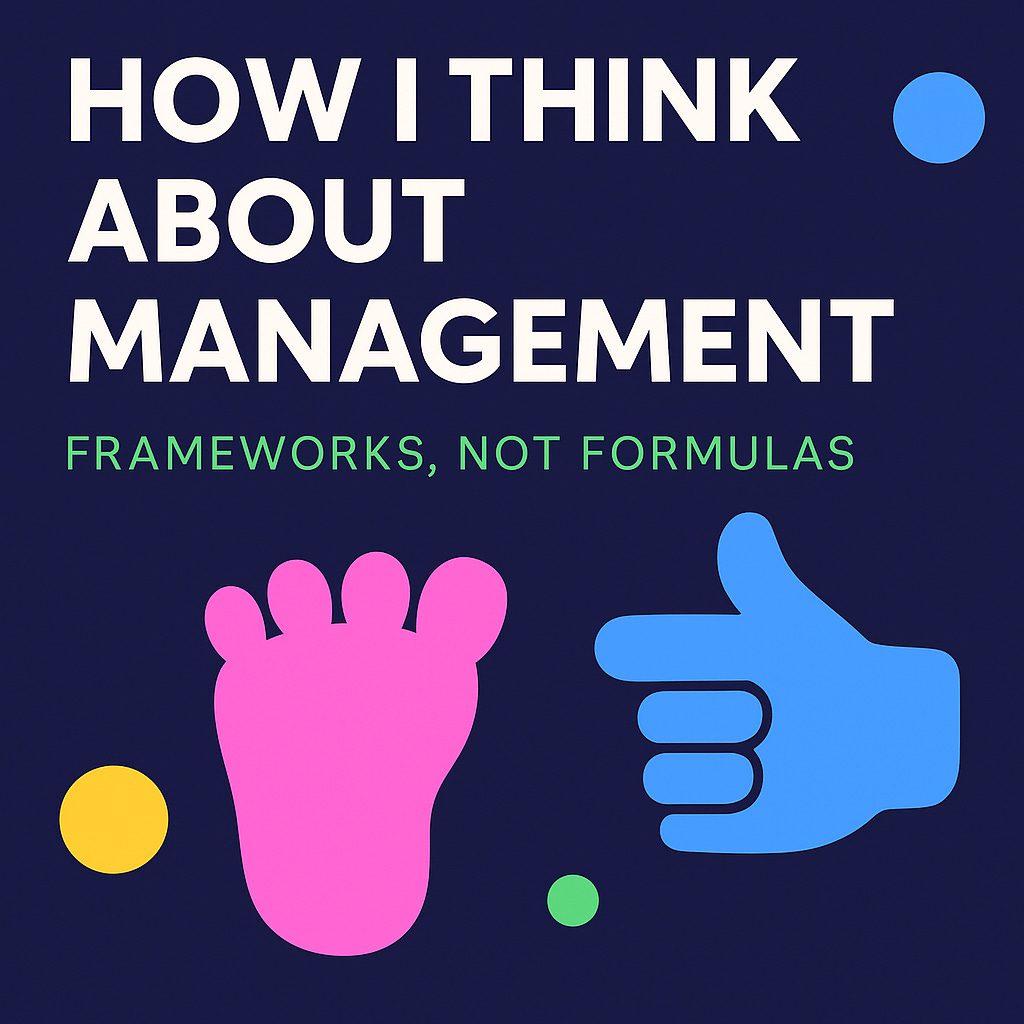
Great managers have short toes (no one’s stepping on them) and nubby fingers (no finger-pointing).

I remember a conversation in my early 20s. I told my boss I wanted to be a manager.
He didn’t even blink. Just said:
“If you manage here, remember: I don’t care about your happiness. I care about your team’s.”
It felt harsh at the time. What he meant wasn’t cruelty—it was responsibility. Management is about putting the team’s needs ahead of your own. And I wasn’t ready.
That moment stuck with me. Even now, many (many?) years later—whenever I talk to someone about moving into management, his line plays back in my head.
Why It Matters
Management isn’t control or a prize. It isn’t a shortcut to status.
It’s a craft. A discipline. You refine it the way you learn a language or an instrument—through repetition, patience, and practice.
Management is the backbone of culture. It sets the tone for how people work, how they grow, and how they feel walking out the door each day.
Done poorly, it’s status theater: titles inflate, attrition spikes, culture rots.
Done well, it’s an act of service: not “I win when I climb higher,” but “I win when my team thrives.”
Frameworks, Not Formulas
I was never someone looking for a book to hand me the “10 rules of management.” That kind of advice—do X, get Y—always felt misleading, how can you apply a formula to people? Some management writing is like that: formulaic. And you should run from it.
The ones worth keeping are different. They come from experience. They offer frameworks, not formulas. They don’t hand you answers, they give you ways to think through scenarios, and problems. It requires more work, but thats the craft of it all.
A mentor told me something once that I carry around and say often:
“I can’t prove fair. I can prove consistent.”
That line stuck. Because formulas try to promise consistency in outcome. But frameworks give you consistency in approach—a way to act that holds up even when inputs are so variable, and nuanced.
Coming from a technical background, management can be brutal. We’re trained to hunt for the right answer, for clean solutions, for repeatable proofs. But management doesn’t live in tidy equations. It lives in the ambiguity of people, conflict, and growth.
What Is a Manager?
Without real management, confusion spreads faster than progress. Teams build the wrong thing, dependencies slip, and surprises land like bombs.
Management isn’t about being the boss—it’s about being the compass.
You make sure they know where they’re going, why it matters and what is expected of them.
Great managers use mistakes to coach, and they learn from their own mistakes. You practice candor that’s clear, kind, and sometimes uncomfortable. You make sure nobody gets blindsided. Ever.
At its core, a manager’s job is responsible for two factors:
Build an environment where people want to stick around and deliver.
Deliver results
Culture, systems, coaching, feedback — all of it flows from those two responsibilities.
What Good Management Looks Like
Defining the role is one thing. Living it is another. So what does good management actually look like when you see it in the wild?
Great managers have short toes (no one’s stepping on them) and nubby fingers (no finger-pointing).
When you inspect a healthy team, with a good manager, here’s what you’ll find:
Context & Direction: Everyone knows not just what they’re working on, but why it matters.
Clear Outcomes: Goals are visible, progress measured, adjustments made.
One Conversation: Whether up, down, or sideways, the story is consistent. No hidden agendas. This is another way to say trust.
Graceful Escalation: Disagreements surface early, with context and coaching. Escalation is never a shock—it’s part of the process.
Systems Thinking: Everyone sees how their piece connects to the larger picture.
No Surprises: Problems move from green to yellow before they hit red. Managers don’t get blindsided.
These are indicators, they can tell you if a team is healthy. But indicators don’t build the health on their own—behaviors do.
Non-Negotiable Management Behaviors
These are some non-negotiable behaviors, I’ve come to expect from managers:
Empathy and Support: Genuine care for team members’ professional and personal growth.
Accountability and Ownership: Own results and challenges, seek solutions, don’t shift blame.
Transparency: Clear is kind. Decisions, changes, and expectations must be shared directly.
Consistency: Hold yourself, the team, and others to the same standard.
Courage: Own mistakes, be wrong, repair trust. Without this, the rest doesn’t matter
All of this applies to any manager. But engineering management comes with its own quirks—the craft inside the craft.
Engineering Managers as a Special Case
Managing engineers is a craft inside the craft. It demands balance: staying technical enough to understand, but not so deep you become the bottleneck.
The best engineering managers fix bugs, write tests, ship small improvements. Close enough to code to stay sharp—but never on the critical path.
It keeps credibility alive.
It create visibility into team, and engineering dynamics.
It opens doors for coaching—because you’re solving alongside others.
Here’s the tension: people first, code second. Credibility comes from connection. From trust. From showing up.
But don’t mistake that for walking away from the work. The terminal may not be your whole job anymore, but it still matters. It’s the bridge between the team and your craft.
Are You Ready to Manage?
Management is not for everyone. It’s not about prestige. It’s about self awareness.
Ask yourself:
Do you care more about the team’s success than your own spotlight?
Can you step back from being the hero so you can build other heroes?
Will you confront challenges head-on, not just for yourself, but for those who count on you?
Does the growth of others inspire you as much as your own?
Do you assume positive intent when interacting with others?
If those questions stir something in you, then maybe you’re ready. Because management is not about you—it’s about why you serve.
Closing the Loop
The longer I’ve managed, the clearer it’s become: management isn’t a promotion, it’s a practice. It isn’t about proving you’re the smartest in the room. It’s about creating the conditions, the space, where the people around you can do their best work and want to keep showing up.
Frameworks help, because they give you something steady to return to when the ground shifts. Formulas fail, because people aren’t formulas. They’re human. Which means every situation comes with context, history, and nuance formulas can’t capture.
If you’re drawn to management, don’t chase the title. Chase the responsibility. Practice the craft. Show up with empathy, accountability, and the courage to be wrong and make it right.
That’s where real leadership begins.
Some potentially useful references
These are listed in no particular order..
Why our generals were more successful in World War II than in Korea, Vietnam or Iraq/Afghanistan (Youtube)
First, Break All the Rules: What the World’s Greatest Managers Do Differently
Start with the Why: How Great Leaders Inspire Everyone to Take Action
Manager Tools Podcast (start with the Hall of Fame selection)
Very well stated! Frameworks have always been my guide. I like to say, you need to get up on the balcony and reflect on what’s happening on the dance floor (your organization), what patterns do you see, what gaps, what opportunities, and how can you, as a manager, better influence the outcomes by improving the foundational elements around and on that dance floor.
My new favorite quote “Management isn’t about being the boss—it’s about being the compass.” - Pete Silberman 😀